The Homeostasis VC agentic sourcing layer
Hey. I'm back with a non-LLM-written honest blogpost reflection on some agentic automations I have built for HVC's success. I was actually surprised to receive so much positive feedback on the last time I did this a few weeks ago. I thought mine was proper 'white belt stuff' in the Data Driven VC game. However, I had multiple experienced investors I respect greatly telling me it was state-of-the-art and urging me to do/share more.
We'll be looking at something which is interesting if you are trying to play in the earliest stage. University spin-out stage. Or even investing pre-company formation: Apparently this is a thing. (A friend told me his investment in a fund that does only pre-inception stage returned 7x already and is expecting more).
So you want to be able to see things before the market picks up the signal. In many cases that means existing tools VCs use are obsolete for this purpose(?) If there are already visible signals, or the founders are already known for their entrepreneurial skills, the market already knows and you lose your price arbitrage of getting in before anyone else dares to. Anyway, you'd get the point, I don't want to linger on this reasoning for too long…
This blogpost is for you if you are into:
- Tech/product being the primary drivers for the data driven funds of the future
- Agentic AI automations that help your fund scale
For HVC, it's a necessity. I have to do this. Otherwise I cannot make it work economically considering the small fund size and a hyper-specialized investment focus. So when I show this stuff to (potential) LPs, stakeholders or partners, I always start with this slide:

HVC is a micro fund (and thus small absolute mgt. fees), but has a heavy research task; Investing in any technology that can make a positive impact on adrenal patients.
To do this, I have summoned our new agentic friends in a set up which can be divided into three categories:
- Initial semantic sourcing (simple)
- The relevance engine (as complex as the relevancy requirements are)
- The cron job (simple, but make sure to steer it well, otherwise it'll start hallucinating)
And as a bonus to that I would add:
- A simple set-up to see/tweak what your agent needs in natural language. If the first three sections don't make sense to you. Start in the bonus section please.
I will walk you through the set-up and show you what I did for HVC. You may slice and dice it as you deem fit for whatever your goals are.
1. Initial Semantic Sourcing
There are three basic steps.
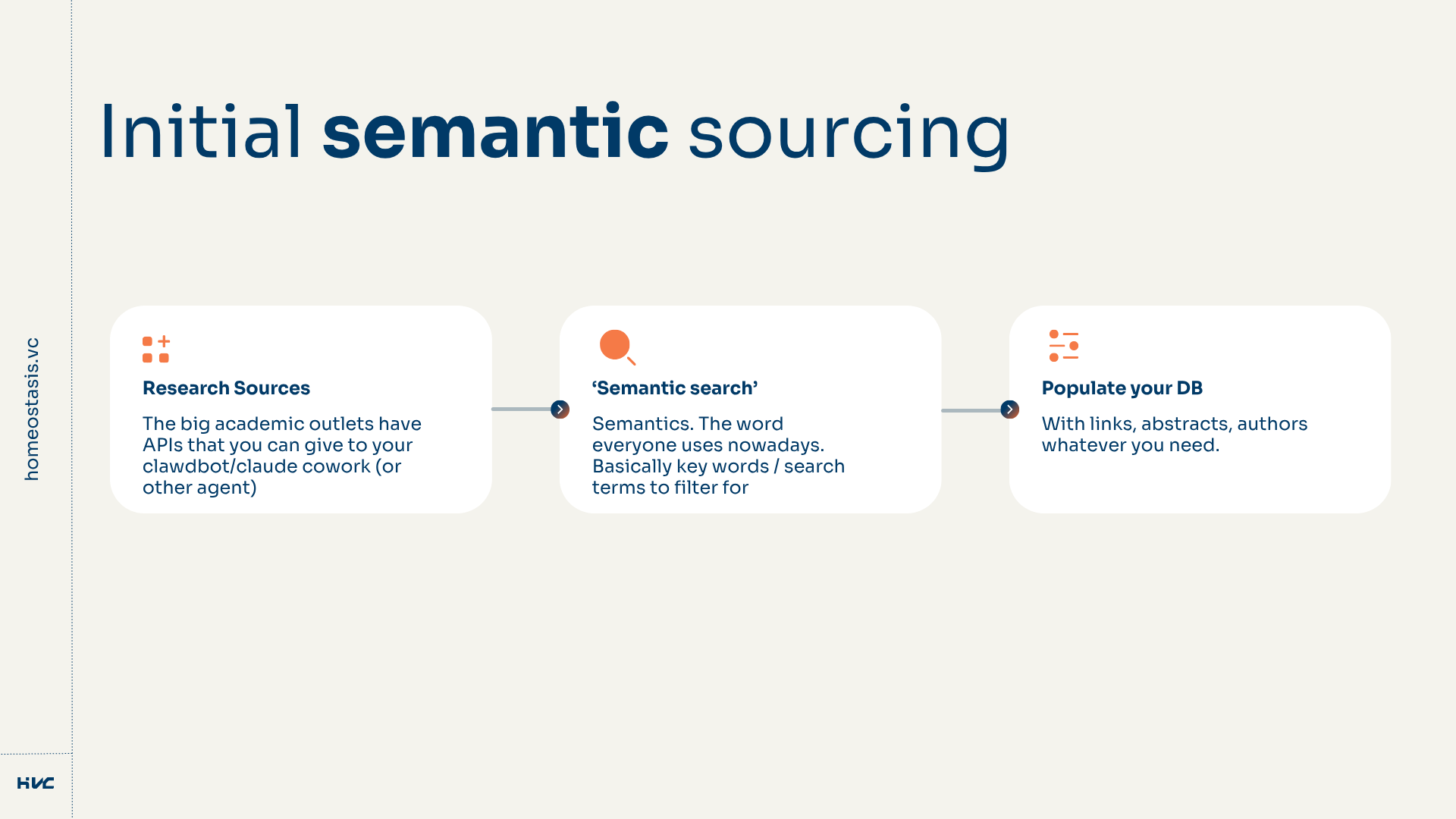
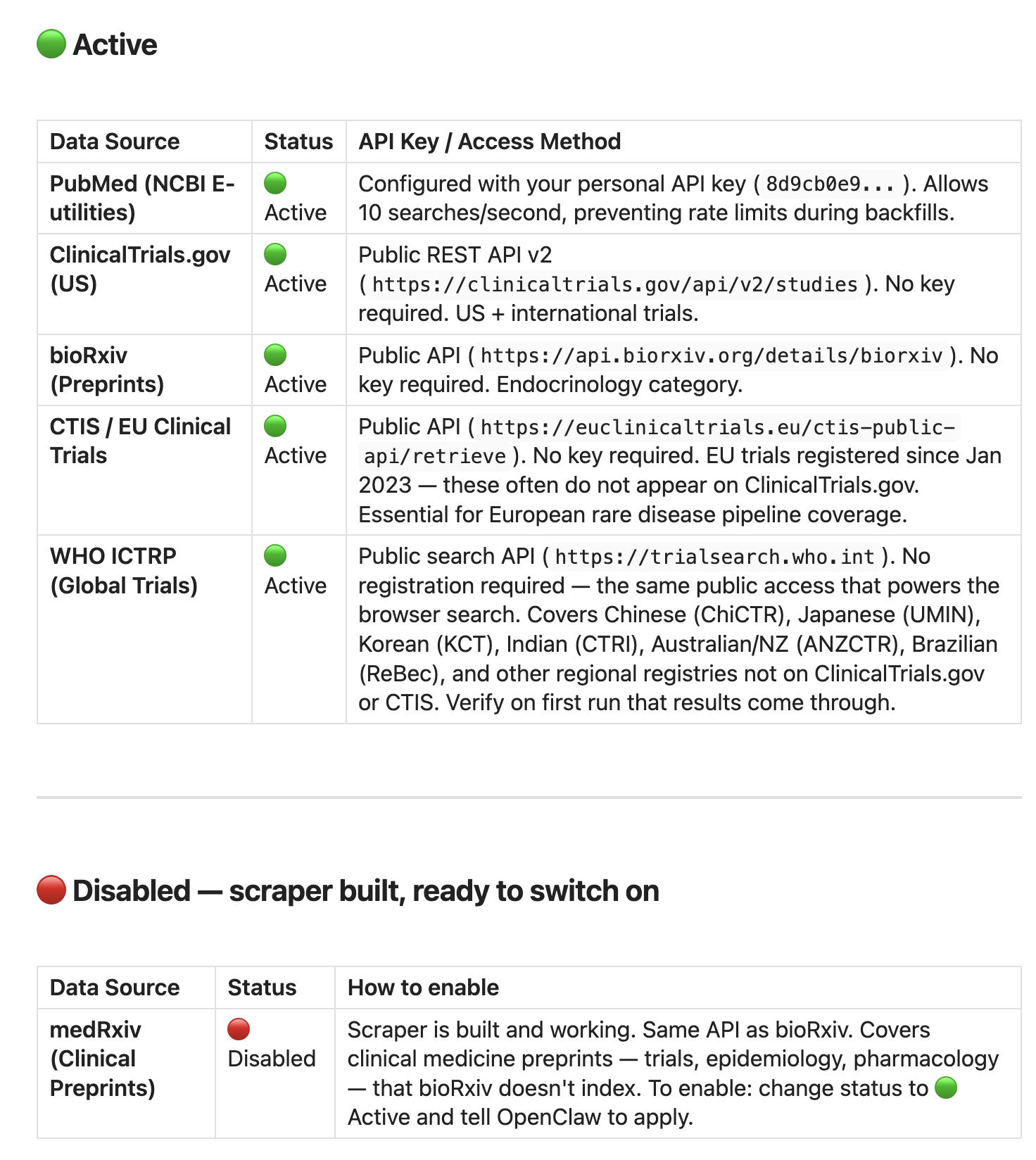
I use Obsidian as a main source for everything and mainly to 'remind' the agent of what's what before it does anything. So in Obsidian my clawdbot and/or claude cowork friends know what research sources are configured:
For the (semantic) search terms. I have a whole list of concepts/terms that I built in collaboration with the HVC adrenal expert network. Not sharing the list here. It's not relevant and terms that wont hit home if you aren't knees deep into endocrine stuff.
However, specifically for our goal. Remember we want to cover anything that could have a potential positive impact on adrenal patients. I have added a separate loop that casts the net very wide.
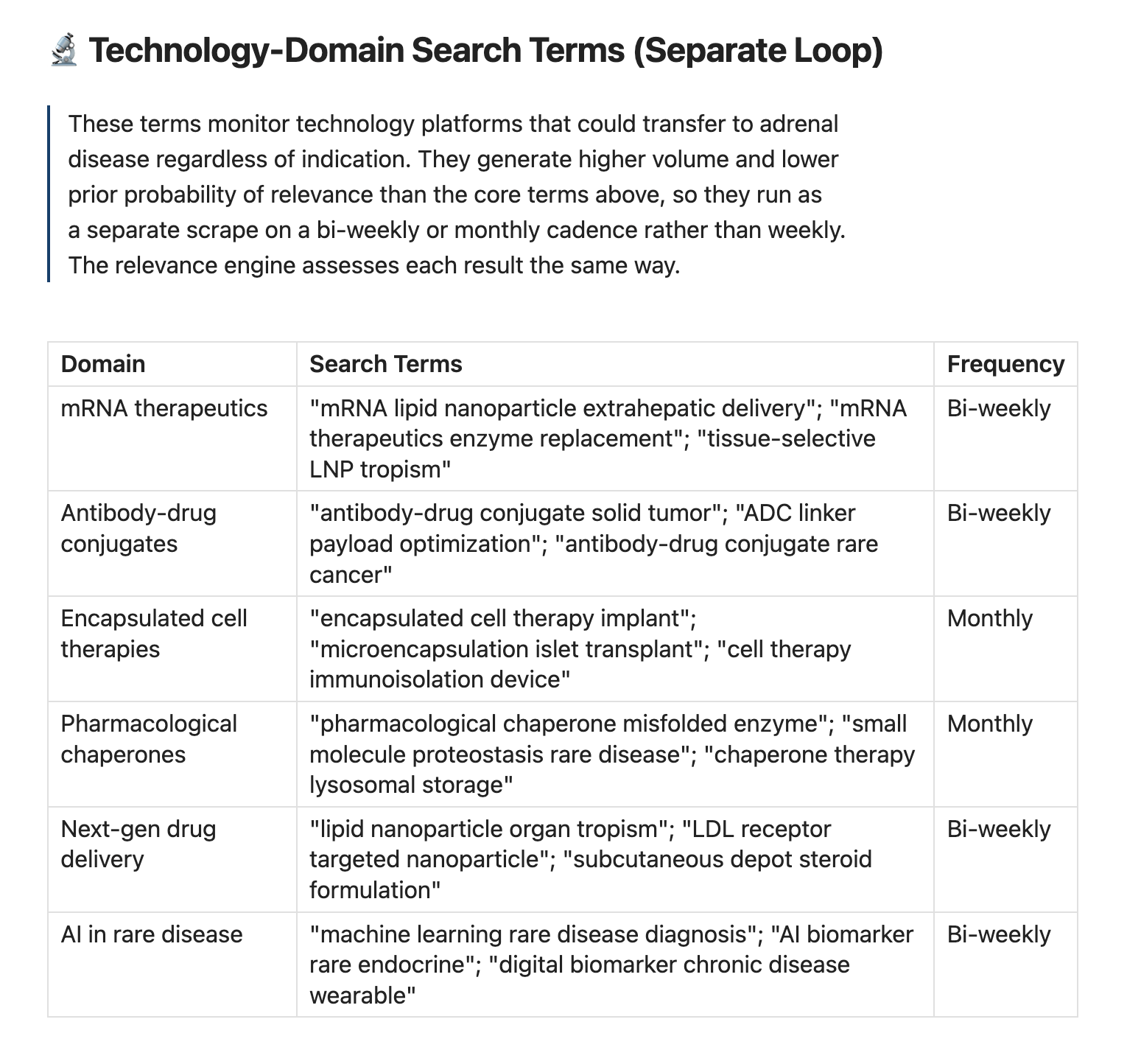
Next is telling it how it should populate your database. Database may sound intense, but it's just to keep track of things. Without telling the agent anything it will just do things in the back which are not convenient to access etc. So I told it how to do it straight in Obsidian as follows:
[emoji] [Paper title]
- Source: PUBMED / CLINICALTRIALS / BIORXIV · [ID linked to original]
- Authors: [name]
- Added: [date]
- Relevance: Direct / Lateral ↔ / Direct + Lateral · [Domain]
- Patient group: [which adrenal condition this helps]
- Unmet need: [which gap this addresses]
- Connection: [one sentence — why this matters for adrenal patients]
- Transfer logic: [only for lateral hits — the technology transfer reasoning]
Ok, great. We have written down the data sources we need, what to search for and how to write down stuff that matches that search.
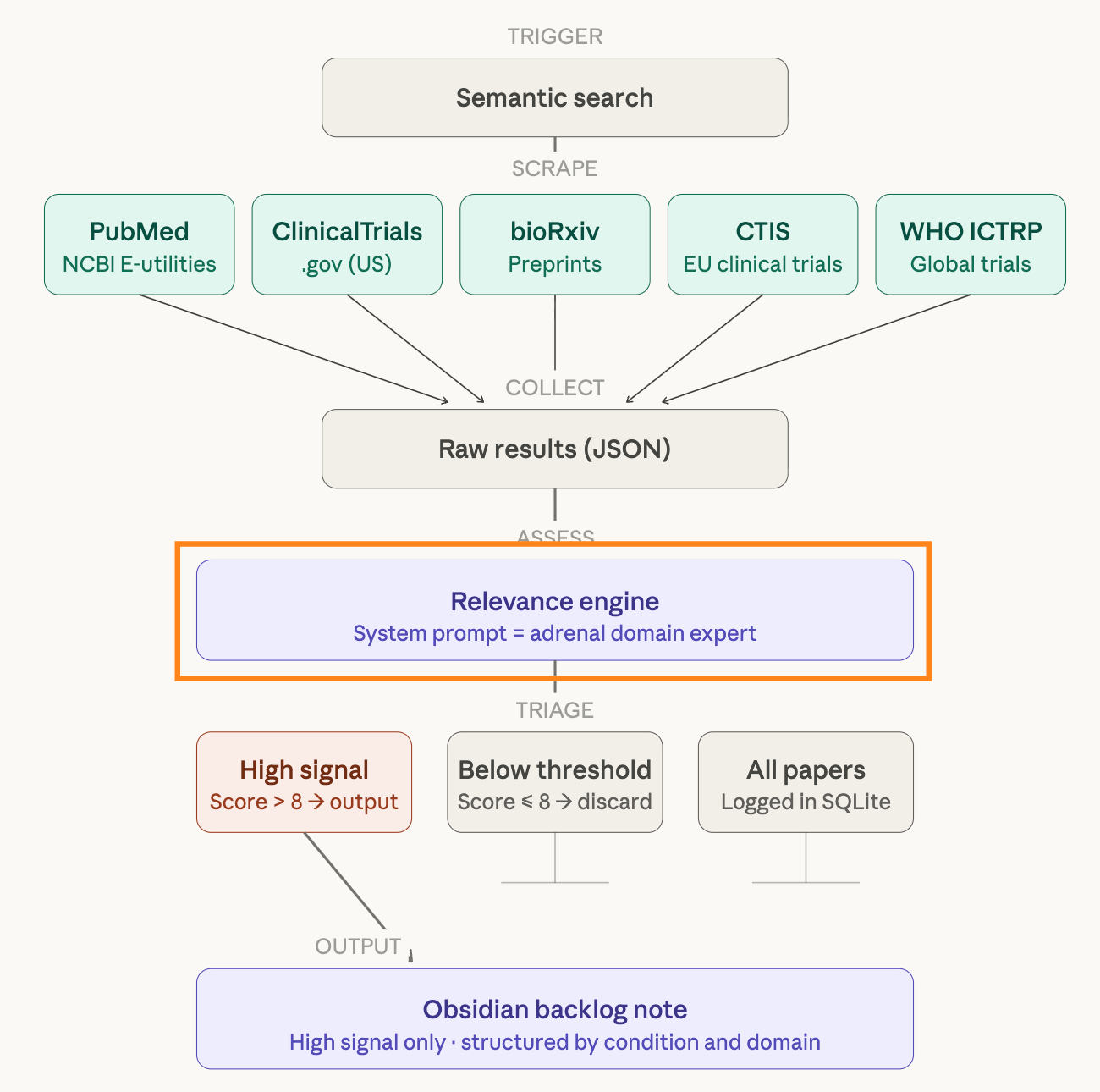
But, do need all of it? No we don’t. This is where the relevance engine comes in.
2. The Relevance Engine
This ‘relevance engine’ is also no rocket science. In fact, none of this is. It’s all logic and being AI fluent enough to ensure your set-up does what it is supposed to do.
However, importantly, we want the agent to do it every time it assesses a result. Hence we need to instruct it to use the exact same system prompt every time. I hear all this stuff about how this is no longer needed and how context windows are extending, but in my experience, you’ll still risk getting ‘hallucinations’ if you don’t instruct it to do the exact same thing every time.
In that system prompt, it gets as complex as you need it to be. Previously, I would advise to use a fine-trained model from hugging face. That is trained on your specific content. I tried this and used something that was fine-tuned on endocrine data. But, to be frank, it was already 4 months old (which is an aeon in AI-land) and Claude’s sonnet 4.6 model has such strong reasoning and such wide/deep training that it would do the same or better. I just used Claude, switched on the mic and told it all that this needs to be. How it needs to be checking this research for things that can be breakthroughs for adrenal patients, how it needs to format that in a system prompt that can be used every time. In a way, telling the agent what it is and what it isn’t. Our ghostly friends need that guidance.
3. The Cron Job (and the back-fill)
This is where I think the real values is in the product built by our Austrian hero who can bench press 350lbs: Openclaw 🦞. Openclaw can do this (assessing if there any new breakthroughs anywhere in the world) autonomously, every week. This will allow us to pick up a signal before it is signal and engage early with its inventors. To do that we’ll set up a cron job.
In also did a back-fill search. Which is virtually the same as the recurring cron-job, but then it’s scraping the date sources for the past 3 years, making sure nothing relevant/recent is omitted. For the back-fill I just used claude cowork and not openclaw (to save API tokens; I am a frugal Dutchie, I know).
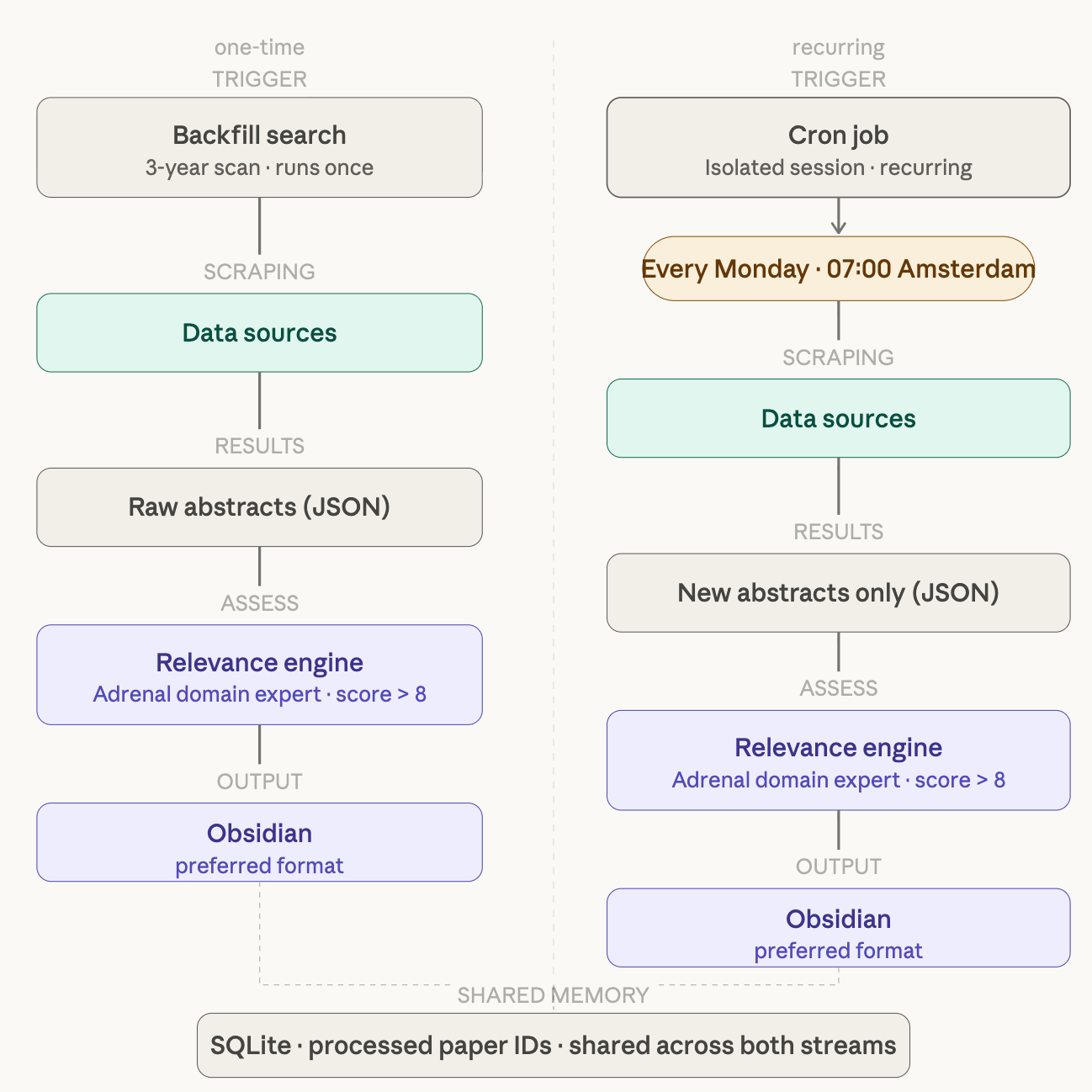
That SQlite stuff is actually important. It is part of the relevance engine; making sure that it doesn’t include papers that are processed already, otherwise I would waste all these tokens on double checking stuff that has already been marked (ir)relevant.
The Control Panel (bonus section)
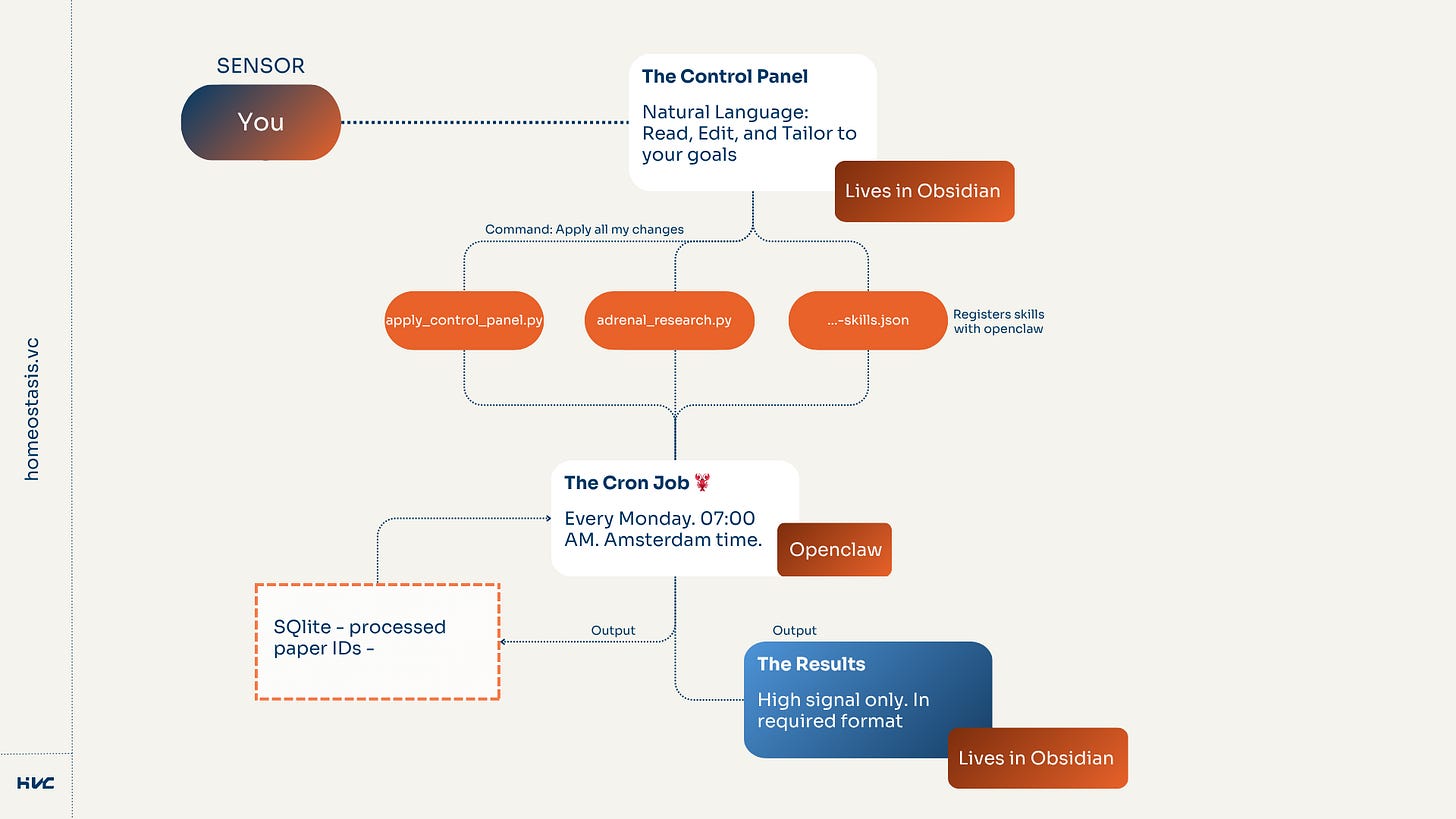
I hate to be prompting away (using voice, as mentioned earlier) and my agent changing the script on the spot. I lose track of what it’s doing and what it’s not doing. It can create 1000 lines of code on a whim. But, I cannot review 1000 lines of code. And I especially hate doing it for every prompt I made. So how do I fix this?
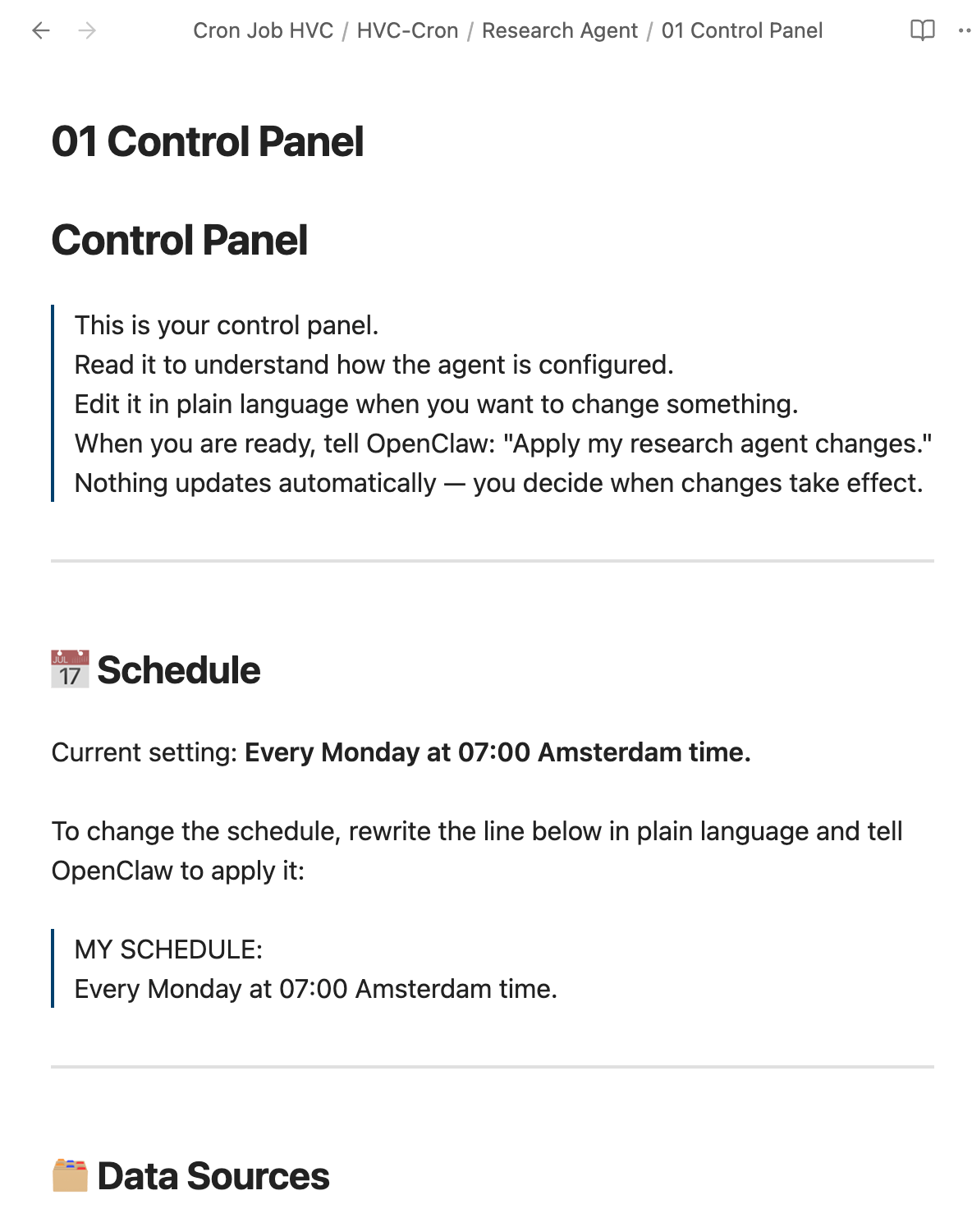
I create a ‘control panel’. A layer in natural language, between me and the script it spews out.
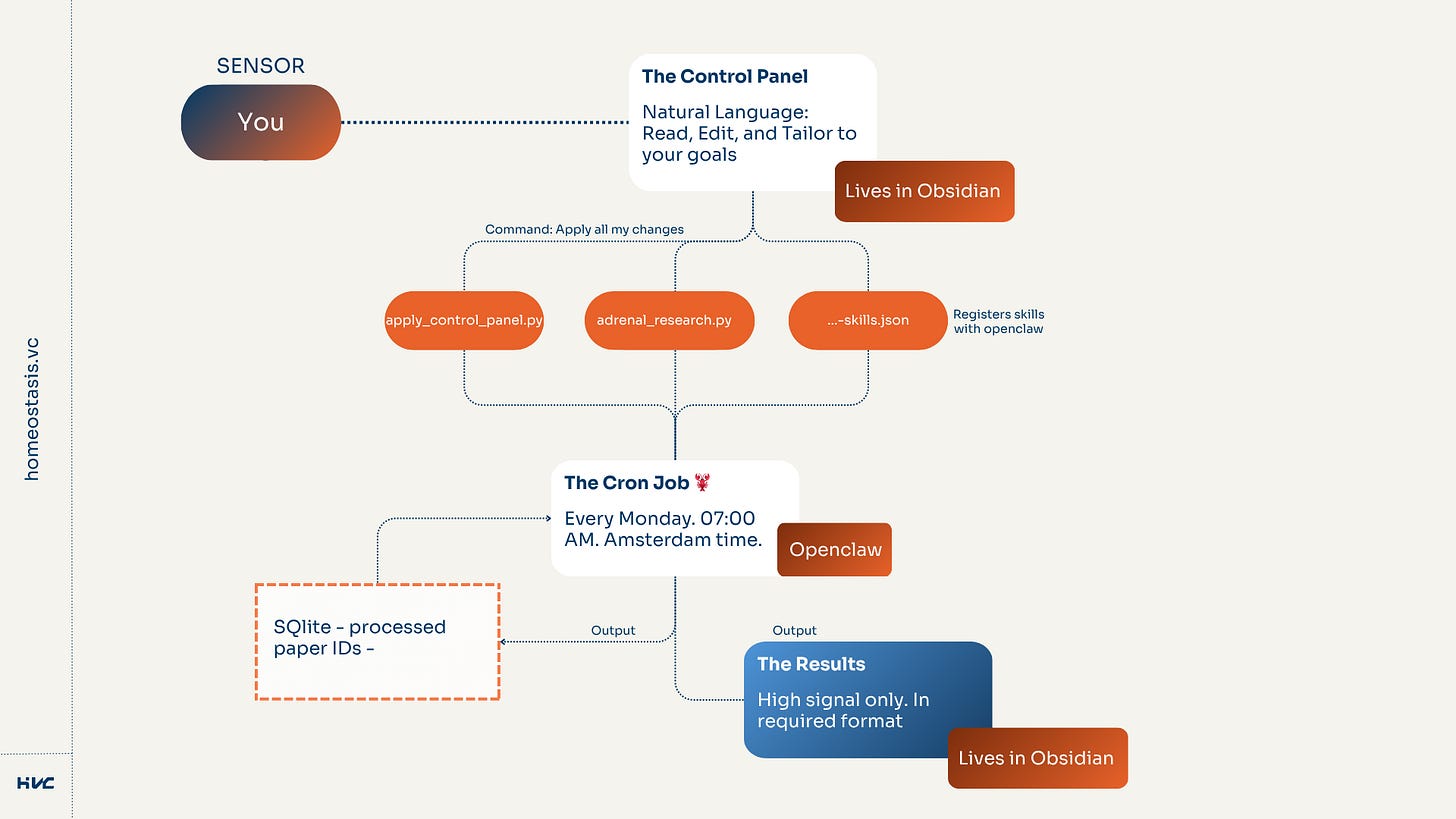
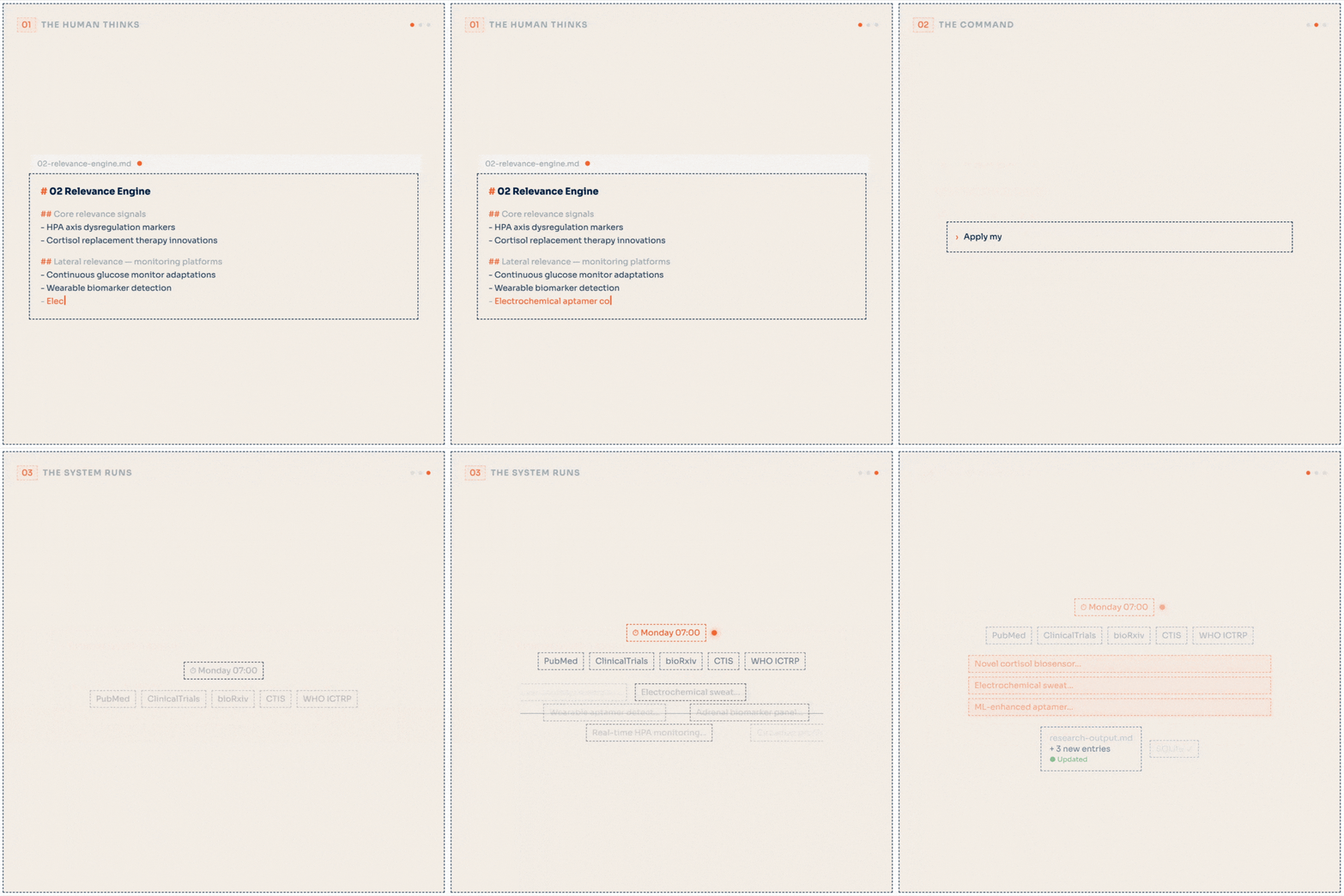
Important to note is that I am not literally writing everything down in my control panel. Again, using voice, prompting away and then have openclaw or claude change it in the control panel. The main reason for having it in between is being able to see what it see what openclaw will and derive its scripts from.
That was it, for today.
Are most VC sourcing tools obsolete? The most annoying answer ever: It depends
- If you are trying to play in the earliest stage? Maybe
- If you are running a low-budget operation? Yes, by necessity. I know for a fact that I wouldn’t have gone through all this hasstle if I had money to blow on a plug-and-play agentic sourcing solution.
- But more than anything, it depends on what you are investing in. I want to invest in anything that has a positive impact on adrenal patients. And I intend to do that early stage. (Because endocrinology is science heavy, but company light).
Anyway, until we meet again, dear reader.
Peace be upon you.
Adriaan